
AI Hack Camp 2026: Winners Emerge After 63 Days of Innovation
Making Korea the Country That Uses AI Best in the World
(Daejeon=Journal Q) Reporter Cho Jae-won — The National Science Museum (Director Kwon Seok-min), a science and technology culture platform that creates dreams for the future, held the “AI Hack Camp 2026” awards ceremony at its Future Technology Hall on Sunday, May 17. A total of 410 teams applied, resulting in a high competition ratio of 34.2 to 1. The competition concluded successfully, demonstrating strong public interest in and expectations for AI technology.
Under the overarching theme of “Developing Innovative AI Solutions That Change People’s Lives,” participants chose one of four categories—digital health (improving public mental health and fostering DTx), digital safety (ensuring the safety of generative AI and detecting deepfakes), digital inclusion (making AI part of everyday life for everyone and closing gaps in access), or digital education (linking AI education with tailored explanations of scientific principles)—and submitted a development plan. Following the call for applications from March 16 to April 24, a total of 410 teams applied: 88 in digital health, 93 in digital safety, 122 in digital inclusion, and 107 in digital education.
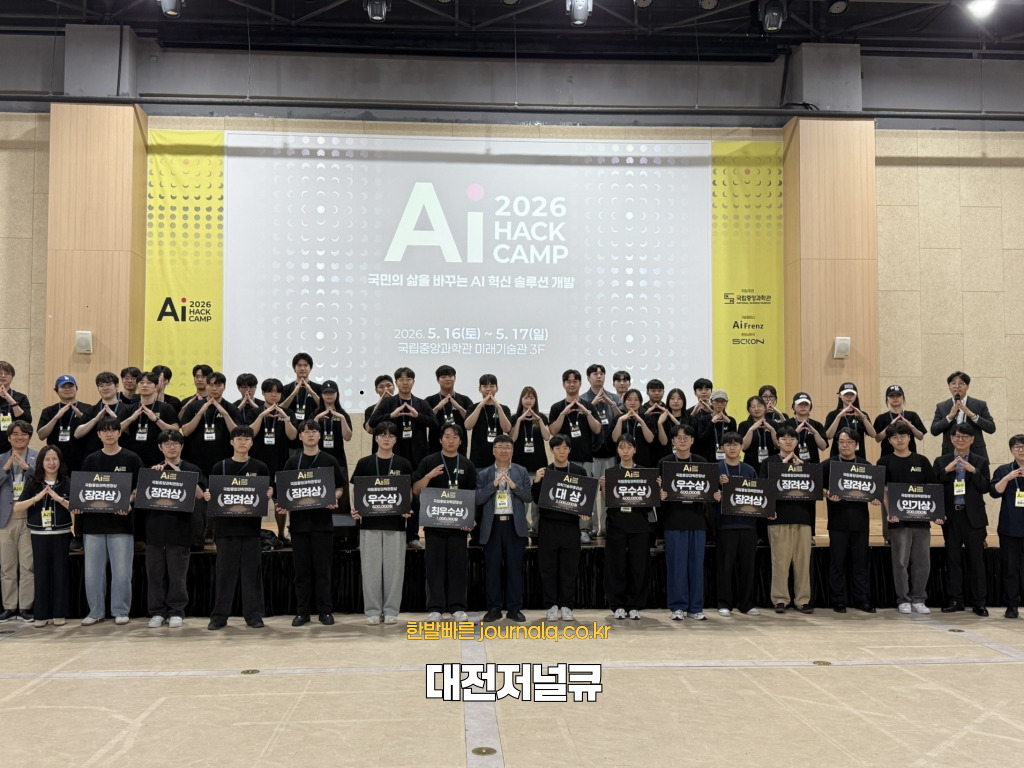
Group photo of AI Hack Camp 2026 participants and award recipients. Photo: JournalQ.
Based on the plans submitted by the participating teams, a panel of expert judges conducted an in-depth evaluation and review designed to ensure expertise and fairness. Three teams from each category, 12 in total, were selected as finalists and announced on May 4. The museum also introduced online voting from May 11 to 16 and on-site voting on May 16, allowing citizens to view and vote on the team introduction videos and development-idea posters produced and submitted by the finalists. The aim was to enhance the public value of AI technology and its resonance with citizens.
At the final competition on May 16–17, a mentoring program involving outside experts helped teams refine their work, and team presentations and expert judging took place. The expert evaluation (70%) assessed suitability, safety, creativity, feasibility, scalability, and other factors in depth. The results were combined with the public vote (30%) to determine the final rankings.
Awards were presented that day to one team for the Grand Prize (the Deputy Prime Minister and Minister of Science and ICT Award, with a cash prize of 2 million won), one team for the Top Excellence Award (the Director-General of the National Science Museum Award, with a cash prize of 1 million won), three teams for Excellence Awards (the Director-General of the National Science Museum Award, with cash prizes of 600,000 won each), one team for the Popularity Award (the Director-General of the National Science Museum Award, with a cash prize of 200,000 won), and seven teams for Encouragement Awards (the Director-General of the National Science Museum Award).
The Grand Prize winner, the DevFive team (four members, including representatives of DevFive Co., Ltd.), developed a conversational AI companion service that helps older people and people with disabilities easily create complex public-sector HWP documents using only speech, photos and handwritten input. The Top Excellence Award winner, the CSI team (four members, including representatives of Hanshin University), developed technology that uses Wi-Fi signals (CSI) and on-device AI to monitor patients’ conditions in real time without cameras or body-worn sensors.
Among the Excellence Award winners, the AI Deepfake Hunters team (four members, including representatives of Gachon University) developed a service that registers the voices of family members and acquaintances in advance as “voice IDs” and verifies them against voices during actual calls in real time; the On-Kid team (four members, including representatives of Hanbat National University) provided a multimodal environment with subtitles, sign language, audio and scene descriptions so that children with hearing or visual disabilities can learn language through the same story content regardless of disability; and the Sregeetong team (four members, including representatives of Korea University) implemented a service that analyzes road-view images with AI to detect physical obstacles such as stairs and steep slopes and guides users to optimal routes that wheelchairs or strollers can actually navigate. Among the Encouragement Award winners, the RadRibbon team (one individual) used AI to analyze past medical records and insurance enrollment histories to find unclaimed insurance benefits and provide one-stop support for filing indemnity health insurance claims by linking with hospital records; the Only Human Beats team (four members, including representatives of Dongguk University) analyzed subtle changes in a person’s blood flow (rPPG) and visual patterns in real time during video calls to determine whether the person was a deepfake; the Chapchu team (two members, including representatives of Pabilica) used AI to analyze the destination URLs and warning signs of QR codes that are difficult to assess visually in real time, helping prevent quishing fraud and malicious app installations and strengthening digital safeguards for vulnerable groups, including older people; the Nongji-an (農地安) team (four members, including representatives of Yonsei University) developed an AI-based SaaS platform that integrates and analyzes satellite imagery, weather data and on-site photos to make the loss-assessment process for crop disaster insurance more objective and automated; the Awaken Science team (four members, including representatives of Google and Seoul National University) developed a service that recreates historical scientists such as Einstein as conversational AI personas to hold real-time discussions and virtual thought experiments with visitors; the Popo team (three members, including representatives of Daelim University) developed an ecological education platform that identifies the species of a plant or animal and whether it is native to Korea from a single photo, and lets users collect entries in the style of a Pokémon Pokédex; and the Fundus2OCT team (four members, including representatives of Ulsan National Institute of Science and Technology) developed an infrastructure technology that uses AI to synthesize OCT cross-sectional images from ordinary fundus photographs without expensive equipment, visualizes the likelihood of glaucoma progression and explains the basis for its assessment to support early diagnosis. The Fundus2OCT team also won the Popularity Award after placing first in the public vote.
Kwon Seok-min, Director-General of the National Science Museum, said, “This competition was not merely a contest of technologies. Its great significance lies in the fact that, as artificial intelligence becomes part of everyday life, members of the public are going beyond being consumers of policy to participate directly as ‘designers of coexistence’ in the AI era and shape the future together.” He added, “I hope the solutions developed through the competition will serve as a practical catalyst for addressing our society’s blind spots and improving quality of life.”